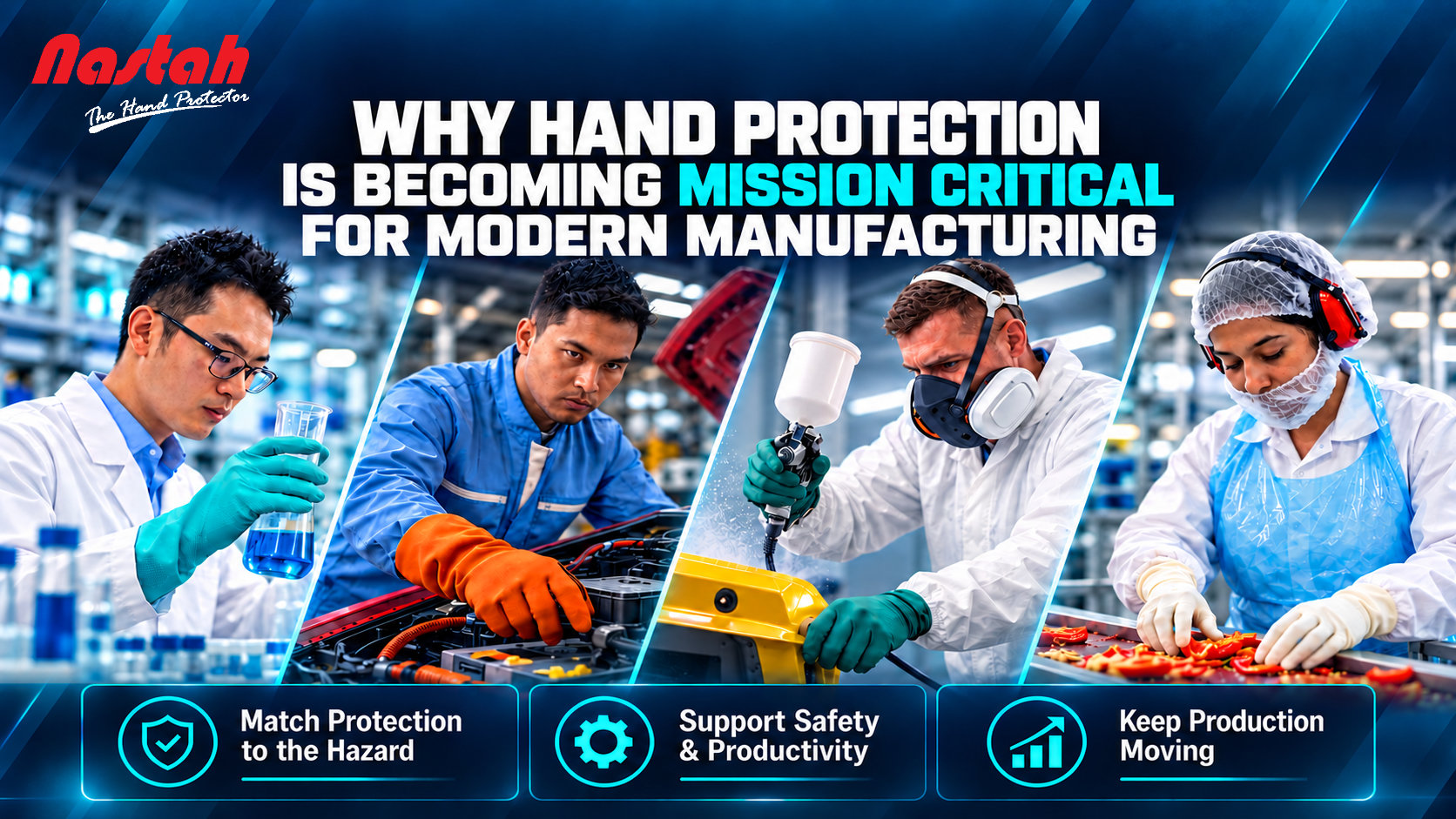

Smart factories are getting faster, more automated and more sophisticated. But even the most advanced manufacturing operation still depends on something remarkably human: hands.
Robotics, AI, automation, electronics and advanced production systems are transforming manufacturing.
Yet workers still handle chemicals, clean machinery, transfer materials, maintain electrical systems, inspect components and perform critical tasks throughout the production process.
Their hands remain directly exposed to many of the hazards that come with those jobs.
Why Industrial Hand Protection Is an Operational Priority
Manufacturers closely monitor production output, downtime, labour efficiency, equipment performance and operating costs.
Workplace hand protection deserves the same level of attention.
Manufacturing workers routinely encounter hazards involving machinery, sharp materials, chemicals, electrical systems, wet processes and repetitive handling.
When a hand injury occurs, the impact can extend beyond the employee involved.
Depending on the incident, it may lead to:
- interrupted production;
- lost working hours;
- investigation and administrative costs;
- temporary labour shortages;
- retraining requirements;
- reduced productivity; and
- disruption to tightly scheduled manufacturing processes.
This is why industrial safety gloves should not be treated as a simple commodity purchase.
The objective is not merely to provide workers with gloves.
It is to select hand protection that matches the actual hazard while allowing employees to perform their work safely and effectively.
One Factory, Multiple Hand Protection Risks
There is rarely one glove suitable for every area of a manufacturing facility.
A worker transferring chemicals does not face the same risk as a technician performing electrical maintenance.
An employee handling ESD-sensitive components has different requirements again.
That means effective workplace hand protection starts with the application, not the glove catalogue.
A useful starting point is to ask:
What is the worker actually exposed to?
The answer determines what the glove needs to do.
Chemical Resistant Gloves for Industrial Chemical Handling
Workers may be exposed to oils, solvents, detergents, cleaning chemicals and other liquids during production, maintenance or industrial cleaning.
For these applications, chemical resistant gloves can play an important role in reducing direct hand exposure.
Reusable chemical resistant nitrile gloves are often selected where users require a combination of:
- chemical resistance;
- durability;
- reliable grip;
- extended cuff coverage; and
- repeated-use performance.
Nastah manufactures a range of reusable nitrile gloves for industrial chemical handling, with different thicknesses, lengths and constructions to suit different working environments.
For procurement teams evaluating a chemical resistant gloves supplier, price should not be the only consideration.
The glove should also be assessed against the chemicals being handled, task duration, working conditions, required coverage and frequency of use.
The lowest-priced glove is not necessarily the lowest-cost option if it is poorly matched to the application.
Heavy-Duty Industrial Gloves for Manufacturing and Maintenance
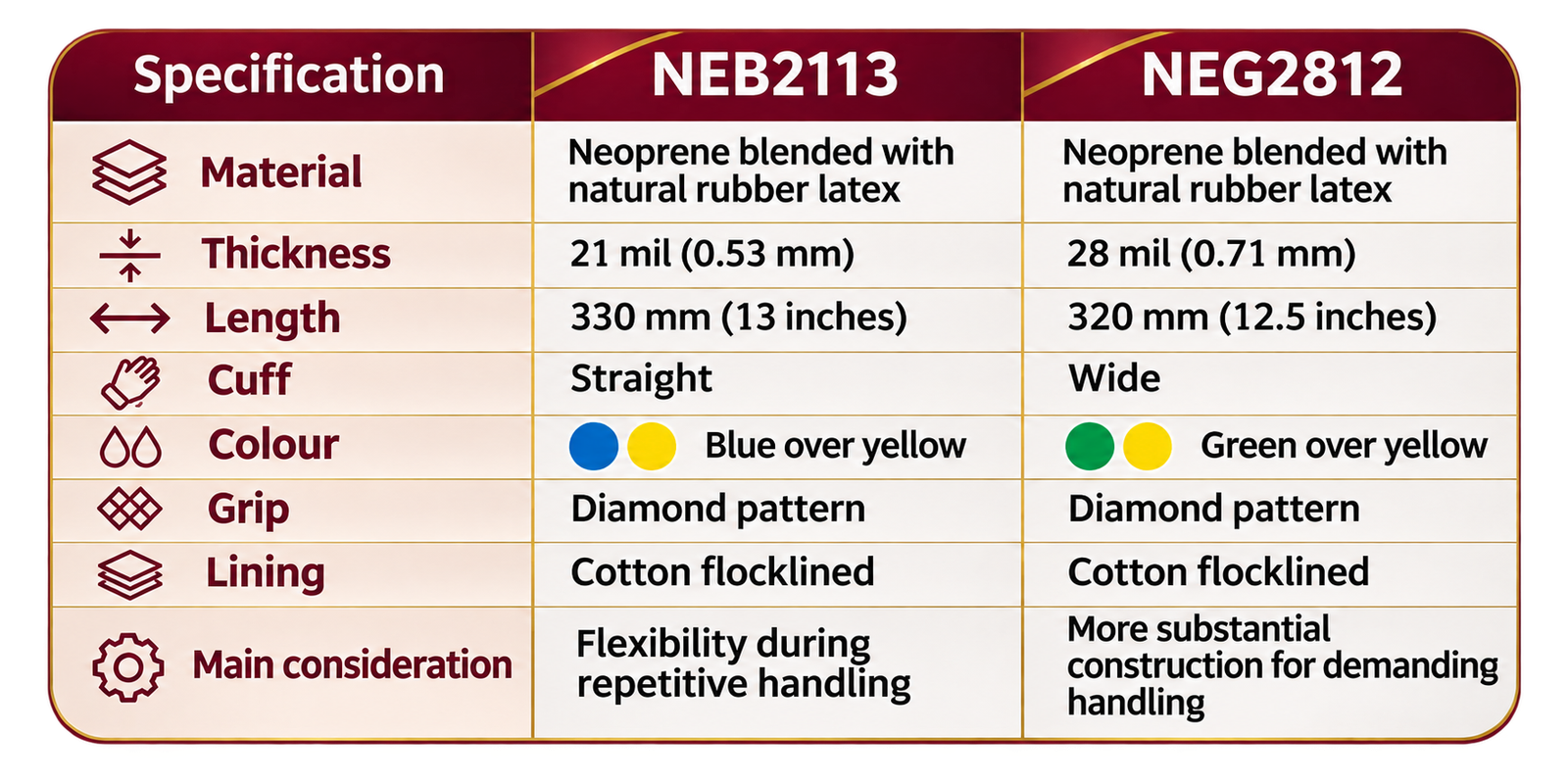
Maintenance, industrial cleaning and general factory work often require more than a lightweight glove.
Workers performing demanding tasks may need heavy-duty industrial gloves that provide stronger durability, better grip and greater hand coverage during repeated use.
Reusable gloves can be especially practical in applications involving:
- wet handling;
- machinery cleaning;
- industrial maintenance;
- oily components;
- repeated material handling;
- cleaning processes; and
- demanding factory environments.
A capable industrial gloves manufacturer should be able to offer options suited to different levels of thickness, durability, cuff length and working conditions.
For buyers, the goal should be to match glove construction to the task rather than selecting one general-purpose glove for every department.
ESD Nitrile Gloves for Electronics Manufacturing
Modern electronics manufacturing introduces another specialised challenge:
electrostatic discharge.
Sensitive electronic components may be vulnerable to static electricity during handling, assembly and production.
That means standard industrial gloves may not be suitable for all electronics applications.
Specialised ESD gloves are designed for environments where electrostatic control is required.
Nastah’s StaticSafe ESD nitrile gloves are developed for applications requiring reusable nitrile hand protection with electrostatic properties.
Unlike conventional fabric ESD gloves, reusable ESD nitrile gloves can also provide a protective barrier in applications involving certain liquids and chemicals, depending on the specific substance and task.
This makes them particularly relevant for industries such as:
- electronics manufacturing;
- semiconductor-related production;
- paint and coatings;
- chemical processing;
- laboratories;
- precision manufacturing; and
- controlled industrial environments.
For distributors and industrial buyers searching for an ESD gloves supplier, reusable nitrile ESD gloves can offer a differentiated alternative where both electrostatic control and barrier protection are important.
Electrical Insulating Gloves for Electrical Safety
Electrical work presents potentially severe hazards and requires dedicated protective equipment.
Standard industrial gloves should never be substituted for properly specified electrical insulating gloves where electrical protection is required.
Nastah’s VOLTNAX Electrical Insulating Gloves include Class 00 and Class 0 options developed for electrical applications.
When selecting electrical safety gloves, buyers should consider:
- voltage class;
- applicable standards;
- inspection requirements;
- working conditions; and
- the exact task being performed.
For companies sourcing from an electrical insulating gloves manufacturer or electrical safety gloves supplier, technical suitability and compliance should always take priority over price alone.
Modern Manufacturing Still Depends on Human Hands
Factories may be getting smarter.
Machines may be getting faster.
Automation may be handling more processes than ever before.
But workers remain essential to manufacturing.
And their hands remain directly involved in countless production, maintenance and handling tasks every day.
That makes industrial hand protection far more than a basic PPE purchase.
The right industrial glove can help an organisation:
protect its workforce, support productivity, reduce operational risk and keep production moving.
For modern manufacturers, choosing the right glove—and the right glove manufacturing partner—is becoming increasingly important.
Whether you are sourcing chemical resistant gloves, reusable nitrile gloves, heavy-duty industrial gloves, ESD nitrile gloves or electrical insulating gloves, our team can help evaluate suitable options for your market or application.
Tell us what your workers handle, the application, the glove you currently use and your estimated annual demand.
Our team will help recommend a suitable Nastah solution.