How Has COVID-19 Reshaped The Gloves Industry?

Industrial Hand Protection for Demanding Working Environments

Industrial operations across construction, manufacturing, surface treatment, painting and cleaning expose workers to abrasive materials, wet surfaces, oils and processing substances. These conditions require protective gloves that balance durability, flexibility, grip and comfort.

Effective hand protection goes beyond glove thickness. Material composition, grip performance and wearing comfort all contribute to safer, more efficient handling during demanding industrial tasks.

Neoprene-blended latex industrial gloves combine the protective properties of neoprene with the natural elasticity of rubber latex, offering versatile hand protection for a range of industrial applications.


Neoprene-Blended Latex Gloves in Industrial Applications

By combining neoprene with natural rubber latex, these reusable gloves provide flexibility, reliable grip and resistance to suitable industrial chemicals and oils.

Their versatility supports several industries:

  • Construction: Handling building materials, tools and wet equipment.
  • Painting and surface preparation: Working with coating materials, containers and suitable stripping substances.
  • Industrial manufacturing: Repetitive handling of components and production equipment.
  • Industrial cleaning: Handling cleaning tools, wet surfaces and compatible cleaning agents.
  • General maintenance: Equipment servicing and handling materials exposed to oils or industrial substances.


Nastah NEB2113 and NEG2812: Industrial Protection for Different Demands

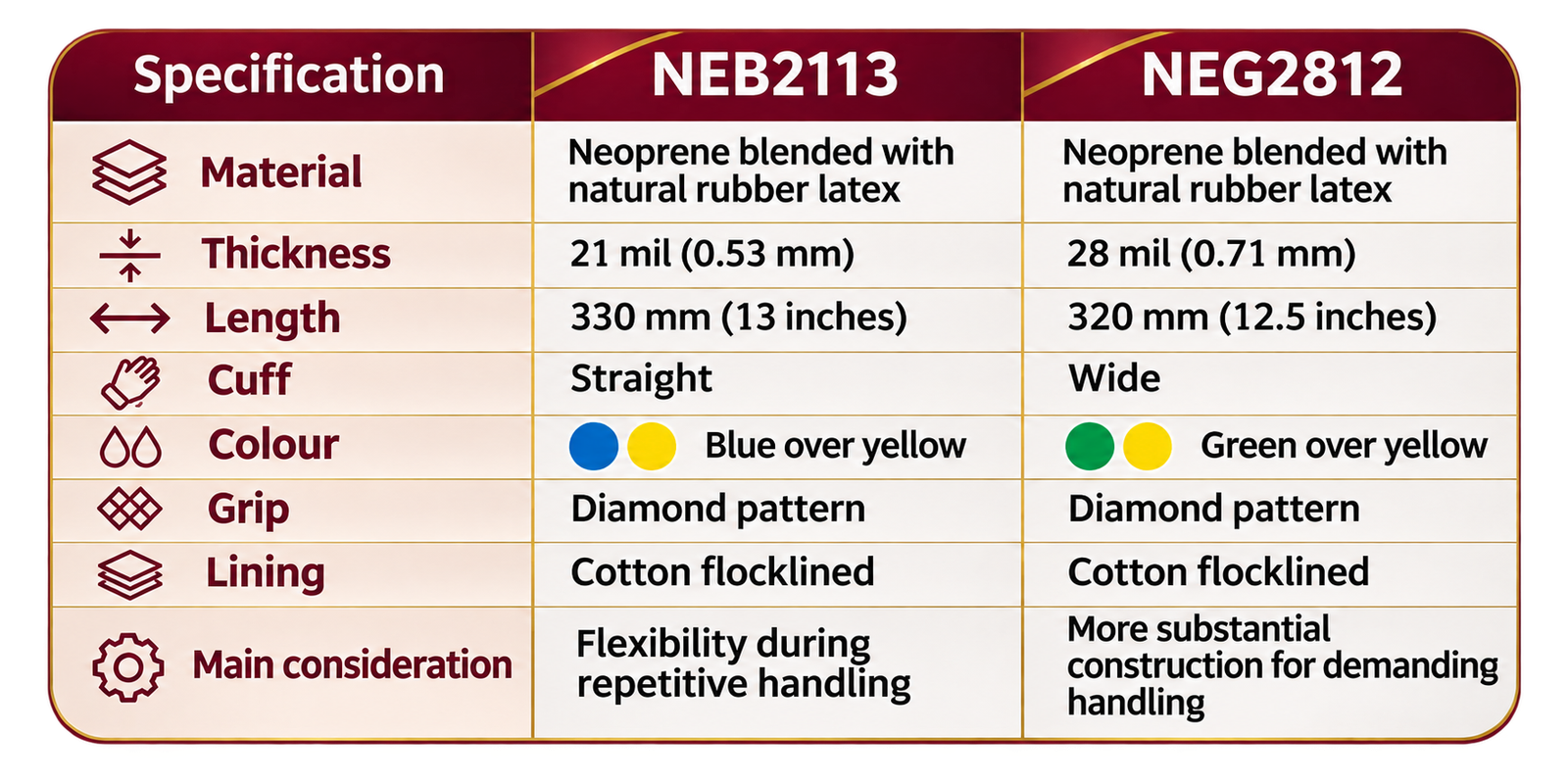
Nastah offers two neoprene-blended latex industrial gloves with different thicknesses and cuff designs to accommodate varying workplace requirements.

The Nastah NEB2113 Neoprene Blended Bi-colour Gloves feature 21 mil (0.53 mm) thickness, a 330 mm (13-inch) length and a straight cuff.

Its comparatively lighter construction prioritises flexibility and ease of movement, making it a practical choice for industrial manufacturing and painting operations that involve frequent, controlled hand movements.

From assembling production components to handling paint rollers and coating equipment, NEB2113 supports repetitive tasks requiring dexterity and consistent handling. Its diamond-pattern grip provides added control, while cotton flock lining contributes to comfortable wear throughout daily operations.


NEG2812: Heavy-Duty Protection for Industrial and Chemical Handling

The Nastah NEG2812 Neoprene Blended Bi-colour Gloves feature 28 mil (0.71 mm) thickness, a 320 mm (12.5-inch) length and a wide cuff.

With its thicker neoprene-latex construction and resistance to specified chemicals and oils, NEG2812 is a practical option for industrial work requiring a more substantial protective barrier.

It is particularly relevant to industrial maintenance, equipment cleaning and suitable chemical-handling operations, where workers encounter oils, cleaning agents and processing substances. Its heavy-duty construction also supports demanding material-handling activities in construction and manufacturing.

The wider cuff facilitates convenient donning and removal, while its PPE Category III and EN ISO 374-1 Type A classification demonstrates tested protection against specified chemicals.


Industrial Performance Beyond Basic Protection

Both NEB2113 and NEG2812 incorporate features that contribute to reliable workplace protection.


Chemical and Oil Resistance

The neoprene-latex blend provides resistance to suitable chemicals and oils, supporting industrial tasks involving exposure to compatible substances.

Secure Grip and Flexibility

Diamond-pattern grip enhances traction when handling wet or slippery materials, while natural rubber latex elasticity supports comfortable hand movement.

Comfort During Extended Wear

Cotton flock lining provides a comfortable interior, helping reduce discomfort during prolonged industrial activities.

Certified Industrial Protection

Both models are classified as PPE Category III and EN ISO 374-1 Type A, providing tested chemical resistance performance. Glove selection should follow the relevant chemical compatibility data and workplace exposure requirements.


Selecting Between NEB2113 and NEG2812

Although both gloves share a neoprene-blended latex construction, their different thicknesses and cuff designs offer distinct advantages.

The COVID-19 pandemic has certainly had a significant impact on every industry, but it’s been fascinating to observe the implications it has had for personal protective equipment and adjacent verticals. 

The glove industry, for example, has seen a range of interesting developments on the back of the pandemic and these are likely to persist for a long time to come. 

Here are some of the most significant ways that the gloves industry has been reshaped: 


Increased Demand

Protective equipment has never been so in demand from all over the world and so gloves manufacturers had to find a way to drastically increase production output in a very short space of time. 

All of a sudden, clients were clamouring to get their hands on what was in limited supply, and it put a lot of relationships to the test. 

The likely implication of this going forward is that more clients will look for retainer contracts that can guarantee them larger volumes of stock, even when times are good. 

Organizations are realizing the importance of having this equipment on hand in case of emergencies like we’ve seen in this pandemic. 


Labour Constraints

The other side of this coin is that the pandemic made it difficult to fill gloves factories with the labourers that were needed to fulfil this high demand, because of the impact of the virus itself on surrounding communities. 

This will undoubtedly lead to discussions about how robust a human workforce is, and with advancements in robotics and automation front of mind – we’ll likely see more gloves manufacturers looking to automate processes wherever possible. 


Supply Chain Considerations

The pandemic showed us that relying too heavily on one particular supply chain, such as China, can leave you vulnerable to macro-economic shocks such as those precipitated by this pandemic. 

As such, clients are looking more seriously into other suppliers in regions like Malaysia to lower their dependence on Chinese goods – the delivery of which was completely halted during the pandemic. 

Clients have started to realize that robustness and consistency of delivery is often more important than just going for the lowest possible cost. 


Focus on Quality

Building on the point above, this pandemic has shown that the quality of gloves that you buy are paramount. 

Cutting corners when it comes to quality in order to save a bit on price really backfires in a pandemic scenario – as many clients have discovered. 

As a result, the industry has been forced to focus more on quality and manufacturers will need to deliver according to the highest international standards in order to stay relevant and maintain consumer trust.

Those are just a few of the ways that this pandemic has reshaped the way that the global gloves industry operates. 

We’re likely to see these implications play out over the next couple of years and it’s hard to see things going back to the way they were before.  This industry has been changed for good. 


About Nastah

If you’re looking for a reliable gloves manufacturer that is well placed to adapt to this changing landscape, then be sure to check out what we’ve got at Nastah.

We’re open for business and would love to see how we could help you.  Get in touch today!   

 

You May Also Like……

Be The First To Know About Our Latest Insights – Subscribe To Our Blog Today!


By subscribing to our blog, you’ll be the first to know about our latest articles and insights.

Simply enter your name and email address in the form below, and select the topics that interest you.

We promise to never share your information with anyone else, and you can easily unsubscribe at any time.