
*Illustrative example only. Actual glove life depends on material, chemical exposure, task, mechanical stress, working conditions and replacement requirements.
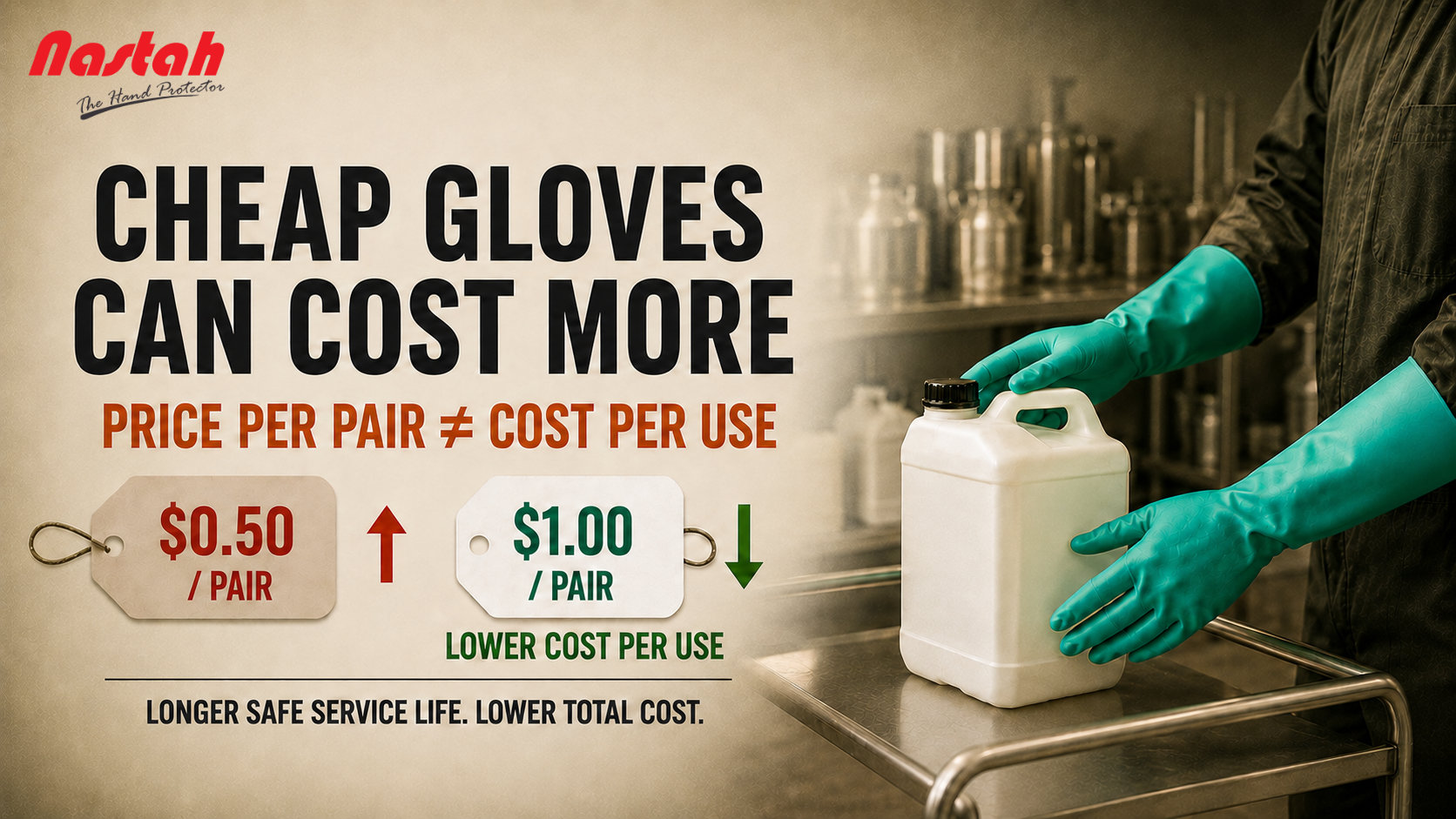
The higher-quality glove costs 100% more per pair.
Yet its cost per working day is:
50% lower.
Across 100 workers and 250 working days:
Economy glove:
$125 × 100 workers = $12,500/year
Higher-quality glove:
$62.50 × 100 workers = $6,250/year
Potential difference: $6,250 per year
And that calculation considers only glove purchasing cost.
It does not yet include worker downtime, inventory handling, disposal or production interruptions.
This is why the lowest-priced glove is not always the lowest-cost glove.
Real Application: Approximately 6× Longer Glove Service Life
This is not only a theoretical calculation.
One Nastah customer, a Malaysian manufacturer, was using a competitor’s glove for a demanding chemical-handling application.
Under its actual operating conditions, the competitor’s glove lasted approximately:
Half a day.
The customer subsequently tested Nastah FLO2812 Heavy Duty Rubber Gloves for the same application.
The reported service life increased to approximately:
3 days of use.
That represents approximately:
6× longer glove service life
To illustrate how significantly service life can affect glove consumption, consider 100 workers operating 250 days per year.
Previous glove
0.5-day service life:
100 × 250 ÷ 0.5 = 50,000 pairs/year
Longer-lasting glove
3-day service life:
100 × 250 ÷ 3 = approximately 8,333 pairs/year
Potential reduction in glove consumption:
Approximately 41,667 pairs — or 83%
This is an illustrative extrapolation based on the difference in reported service life. Actual results will vary depending on the chemicals involved, exposure duration, glove condition, work process and workplace safety requirements.
But the commercial principle is clear:
A higher price per pair does not necessarily mean a higher cost of protection.
When a glove safely lasts significantly longer in the same application, the cost per use and Total Cost of Ownership can be considerably lower.
Could Your Factory Achieve Similar Savings?
If your workers are replacing gloves frequently because of tearing, premature wear or chemical deterioration, there may be an opportunity to reduce your overall glove consumption.
Send Nastah your:
- Current glove model
- Current application
- Chemicals handled
- Approximate replacement frequency
- Monthly or annual consumption
We can help you identify a suitable Nastah glove for a side-by-side evaluation.
The Hidden Costs Behind Frequent Glove Replacement
The financial impact of a short glove service life goes beyond the number of pairs purchased.
- Worker Downtime
Every glove replacement requires a worker to stop what they are doing.
Depending on the workplace, the worker may need to:
- stop the task;
- remove and dispose of the glove;
- obtain a replacement pair;
- put on the new glove;
- return to the workstation; and
- restart the task.
One glove change may take only a few minutes.
But across hundreds of employees and thousands of replacements, those minutes add up.
A longer-lasting glove can therefore potentially help reduce unnecessary work interruptions as well as PPE consumption.
- Inventory and Warehouse Costs
More glove consumption means more:
- purchase orders;
- cartons;
- deliveries;
- warehouse space;
- inventory movements;
- stock issuance;
- replenishment planning; and
- internal handling.
If a factory can reduce annual glove consumption without compromising worker protection, the benefit extends beyond the glove purchasing budget.
There may also be less inventory to receive, store, manage and distribute.
- Waste Generation
Every glove that is discarded becomes waste.
If one suitable reusable glove safely performs the work of several shorter-lived gloves, fewer pairs need to be purchased and fewer pairs ultimately need to be discarded.
For companies monitoring resource efficiency and PPE consumption, service life is therefore both a financial and operational consideration.
- Production Disruptions
A glove that tears or fails during a task can interrupt production at the wrong moment.
This can be especially disruptive in applications such as:
- chemical processing;
- automotive manufacturing;
- oil and gas;
- maintenance;
- industrial cleaning;
- metalworking;
- food processing; and
- general manufacturing.
Consistent glove performance contributes to more predictable operations.
For industrial buyers, that consistency has value.
For Chemical-Resistant Gloves, Longer Life Is Not Enough
There is an important qualification.
A glove is valuable only when it remains suitable for the actual hazard involved.
A thicker glove or a glove that is mechanically difficult to tear is not automatically the correct glove for chemical handling.
Buyers should also evaluate factors such as:
- glove material;
- chemicals being handled;
- chemical concentration;
- permeation performance;
- breakthrough time;
- exposure duration;
- glove thickness;
- cuff length;
- grip requirements;
- mechanical demands; and
- applicable PPE standards.
For chemical-protective gloves, standards such as EN ISO 374 can provide important information when evaluating suitability for different chemical hazards.
That means industrial gloves should be assessed from two perspectives:
Protection Performance
Is the glove suitable for the actual hazard and application?
Economic Performance
How long can the glove safely remain in use before it requires replacement?
The objective is not simply to find the glove that lasts the longest.
It is to find the glove that provides:
Appropriate Protection + Reliable Service Life + Competitive Cost Per Use
How to Calculate Your Current Glove TCO
You do not need a complicated financial model to begin evaluating glove costs.
Start with four simple steps.
Step 1: Measure Current Consumption
Record the number of pairs currently issued per:
- worker;
- department;
- production line; or
- month.
This gives you a baseline.
Step 2: Measure Actual Service Life
Determine how long the glove normally remains safely usable under your actual operating conditions.
For example:
- 4 hours;
- half a day;
- 1 day;
- 3 days; or
- 1 week.
Do not rely only on catalogue claims.
A controlled workplace trial provides far more meaningful information.
Step 3: Calculate Cost Per Working Day
Use:
Cost Per Working Day = Price Per Pair ÷ Average Safe Service Life
For example:
A $0.60 glove lasting one day:
$0.60 ÷ 1 = $0.60/day
A $1.20 glove lasting four days:
$1.20 ÷ 4 = $0.30/day
Although the second glove costs twice as much per pair, its cost per working day is 50% lower.
Step 4: Calculate Annual Impact
Once you know the service life, calculate projected annual consumption:
Annual Glove Consumption = Number of Workers × Working Days ÷ Average Service Life
Then compare:
- annual glove purchasing cost;
- replacement frequency;
- glove consumption;
- inventory requirements;
- worker interruptions;
- waste generation; and
- protection performance.
This gives procurement teams a far more meaningful comparison than quotation price alone.
Signs Your Current Gloves May Be Costing Too Much
It may be worth conducting a glove TCO evaluation if your operation regularly experiences:
- premature glove tearing;
- frequent replacements;
- high monthly glove consumption;
- chemical deterioration;
- inconsistent product quality;
- insufficient grip;
- worker complaints;
- frequent emergency stock replenishment; or
- increasing annual glove consumption despite negotiating lower purchase prices.
If these problems are happening regularly, negotiating another few cents off the purchase price may not address the real issue.
Improving glove performance and service life may create a much larger saving.
Stop Buying Gloves on Price Alone
Procurement teams naturally need to control costs.
But the strongest purchasing decision is not always the one that produces the lowest price per pair.
It is the decision that delivers the required protection at the lowest sustainable total cost.
For reusable industrial gloves, the relationship is straightforward:
Longer Safe Service Life
↓
Fewer Replacements
↓
Lower Glove Consumption
↓
Lower Cost Per Use
↓
Lower Total Cost of Ownership
That is why higher-quality industrial gloves should not automatically be viewed as a higher expense.
In the right application, they may actually be the lower-cost solution.
Stop Comparing Price Per Pair. Start Comparing Cost Per Use.
Your current glove may be cheaper to purchase.
But is it cheaper per working day?
Is it reducing your annual glove consumption?
And is it really delivering the lowest overall cost to your operation?
Send us your current glove specifications and usage data. Let us help you calculate the true cost of your gloves.
Tell us what glove you currently use, what you pay per pair and how frequently it needs to be replaced. Our team will help you assess whether a higher-performance reusable glove could lower your actual cost per use.