Watch out for these two types of hand hazards! (Video)

Industrial Hand Protection for Demanding Working Environments

Industrial operations across construction, manufacturing, surface treatment, painting and cleaning expose workers to abrasive materials, wet surfaces, oils and processing substances. These conditions require protective gloves that balance durability, flexibility, grip and comfort.

Effective hand protection goes beyond glove thickness. Material composition, grip performance and wearing comfort all contribute to safer, more efficient handling during demanding industrial tasks.

Neoprene-blended latex industrial gloves combine the protective properties of neoprene with the natural elasticity of rubber latex, offering versatile hand protection for a range of industrial applications.


Neoprene-Blended Latex Gloves in Industrial Applications

By combining neoprene with natural rubber latex, these reusable gloves provide flexibility, reliable grip and resistance to suitable industrial chemicals and oils.

Their versatility supports several industries:

  • Construction: Handling building materials, tools and wet equipment.
  • Painting and surface preparation: Working with coating materials, containers and suitable stripping substances.
  • Industrial manufacturing: Repetitive handling of components and production equipment.
  • Industrial cleaning: Handling cleaning tools, wet surfaces and compatible cleaning agents.
  • General maintenance: Equipment servicing and handling materials exposed to oils or industrial substances.


Nastah NEB2113 and NEG2812: Industrial Protection for Different Demands

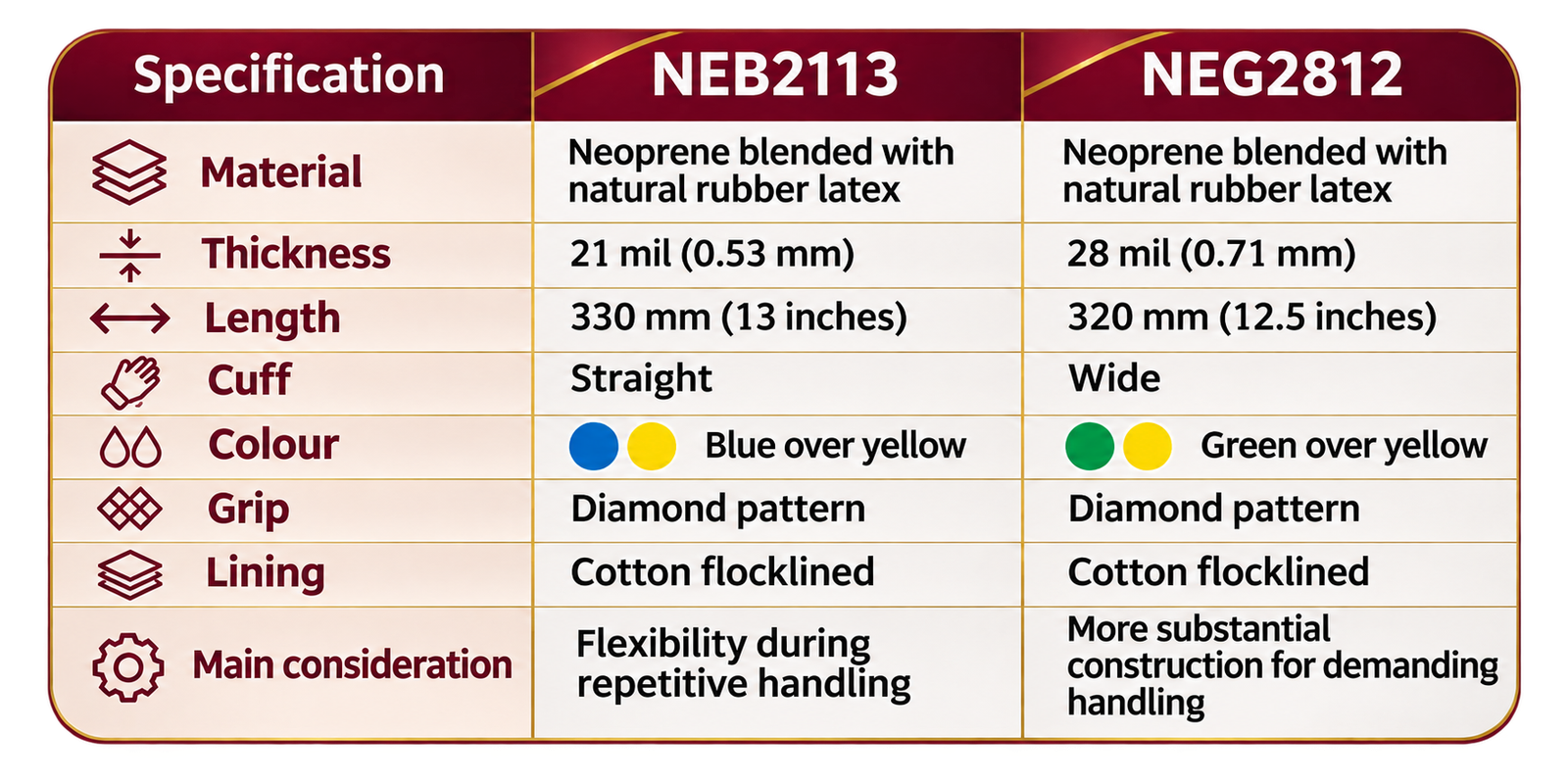
Nastah offers two neoprene-blended latex industrial gloves with different thicknesses and cuff designs to accommodate varying workplace requirements.

The Nastah NEB2113 Neoprene Blended Bi-colour Gloves feature 21 mil (0.53 mm) thickness, a 330 mm (13-inch) length and a straight cuff.

Its comparatively lighter construction prioritises flexibility and ease of movement, making it a practical choice for industrial manufacturing and painting operations that involve frequent, controlled hand movements.

From assembling production components to handling paint rollers and coating equipment, NEB2113 supports repetitive tasks requiring dexterity and consistent handling. Its diamond-pattern grip provides added control, while cotton flock lining contributes to comfortable wear throughout daily operations.


NEG2812: Heavy-Duty Protection for Industrial and Chemical Handling

The Nastah NEG2812 Neoprene Blended Bi-colour Gloves feature 28 mil (0.71 mm) thickness, a 320 mm (12.5-inch) length and a wide cuff.

With its thicker neoprene-latex construction and resistance to specified chemicals and oils, NEG2812 is a practical option for industrial work requiring a more substantial protective barrier.

It is particularly relevant to industrial maintenance, equipment cleaning and suitable chemical-handling operations, where workers encounter oils, cleaning agents and processing substances. Its heavy-duty construction also supports demanding material-handling activities in construction and manufacturing.

The wider cuff facilitates convenient donning and removal, while its PPE Category III and EN ISO 374-1 Type A classification demonstrates tested protection against specified chemicals.


Industrial Performance Beyond Basic Protection

Both NEB2113 and NEG2812 incorporate features that contribute to reliable workplace protection.


Chemical and Oil Resistance

The neoprene-latex blend provides resistance to suitable chemicals and oils, supporting industrial tasks involving exposure to compatible substances.

Secure Grip and Flexibility

Diamond-pattern grip enhances traction when handling wet or slippery materials, while natural rubber latex elasticity supports comfortable hand movement.

Comfort During Extended Wear

Cotton flock lining provides a comfortable interior, helping reduce discomfort during prolonged industrial activities.

Certified Industrial Protection

Both models are classified as PPE Category III and EN ISO 374-1 Type A, providing tested chemical resistance performance. Glove selection should follow the relevant chemical compatibility data and workplace exposure requirements.


Selecting Between NEB2113 and NEG2812

Although both gloves share a neoprene-blended latex construction, their different thicknesses and cuff designs offer distinct advantages.

Take a look at your hands. Stretch your fingers apart and try to fold your thumb towards your palm. Now, try to pick up things from your table. Is it difficult?

This is just a demonstration of the effect of hand injury that happened at the workplace every day. In the workplace, we do not want to keep our fingers crossed and hoping that there will never be any serious injuries. Health and Safety issue is preventable with the right personal protective equipment (PPE) for hands.

According to the Safety and Health Council of North Carolina, the five most common hand injuries in the workplace include lacerations (63%), crushes (13%), avulsions or detachments (8%), punctures (6%) and fractures (5%).

In this blog post, we will learn about two main hand hazards that are common in the workplace, which is mechanical hand hazards and chemical hand hazards. On the other hand, we will be guiding you on how to prevent these hazards by choosing the right gloves. 


What are mechanical hand hazards?

Mechanical hazards are present when working with machineries or equipment, including moving parts of the machine, power transmission apparatus eg. pulleys, belts, couplings, chains, gears etc.

This hazards also present where work is performed on the material, such as cutting and shaping of the metal sheet.


mechanical hand hazards

How to choose gloves to handle mechanical risks?

In our previous post, we have talked about EN388, which is the European standard used to evaluate mechanical risks for hand protection.

In that blog post, we guide our readers on how to read the pictogram to determine the glove performance based on 4 main aspects, which are are abrasion resistance, blade cut resistance, tearing strength and puncture strength.

When choosing protective gloves to be used in mechanical situations, make sure to evaluate how the work will be carried out and what sorts of hazards need to be addressed at that workplace.

For example, if the worker is handling metal sheet, you might want to look for safety gloves that provide good cut resistance. If the worker is handling materials at the construction site, safety gloves with good abrasion resistance is recommended.

Always involve the employees and let them try on the gloves and get their feedback. Hand safety is not only about getting compliance with the rules and regulations, but also about protecting the life of your workers.


What are chemical hand hazards?

Different chemicals will have different adverse effects on the hands and arms, from mild irritation to contact dermatitis or corrosive burns. Chemical burns occur when skin comes into contact with acids, alkali, or other type of strong chemicals.


chemical hand hazards


Sometimes, the effect does not appear right away, it may take months or years of exposure to a chemical to start seeing skin damage.

Based on the type of chemical exposure, it can either damage the skin directly by causing irritation, sensitization etc., or it can be absorbed to the skin and end up become cancerous.

Without adequate risk assessment and controls the results of this exposure can be detrimental.


How to choose gloves to handle chemical risks?

Well, selecting the right chemical resistance gloves involves more than just picking the right size.

You will need to consider the material that being handled in the workplace, the particular hazard involved eg. the specific solvent or the chemical the worker is working with, and the suitability of the gloves for that operation.

If you wish to know more about which type of gloves are recommended to work with which chemical, we have got ready a chemical resistance guide with degradation rating for you.

Click the picture below to download the guide.


chemical resistance guide


Other than that, you must also identify if the gloves have meet the EN ISO 374-1:2016 standard.

We have recently written a blog post about the standard behind chemical resistant gloves, explaining the penetration test, permeation test and degradation test of a chemical resistance nitrile glove in a simplified manner, which might be helpful for those who are looking for chemical resistance gloves.


Conclusion

When looking for gloves to be used in the workplace, it is especially important to communicate your application needs with the glove manufacturer. 

As different working environment and users will have different needs, it is advisable to define the individual requirements and consult the gloves manufacturer for the specific protective performance of the gloves needed. 

Feel free to reach out to our gloves expert in the link below, they will get back to you within 1 working day.

They say a craftsman’s best tool is his hands. So, make sure to use appropriate protective gloves to protect one of your most important assets. Work safe, stay safe!


You May Also Like……

Be The First To Know About Our Latest Insights – Subscribe To Our Blog Today!


By subscribing to our blog, you’ll be the first to know about our latest articles and insights.

Simply enter your name and email address in the form below, and select the topics that interest you.

We promise to never share your information with anyone else, and you can easily unsubscribe at any time.