Smart factories are getting faster, more automated and more sophisticated. But even the most advanced manufacturing...


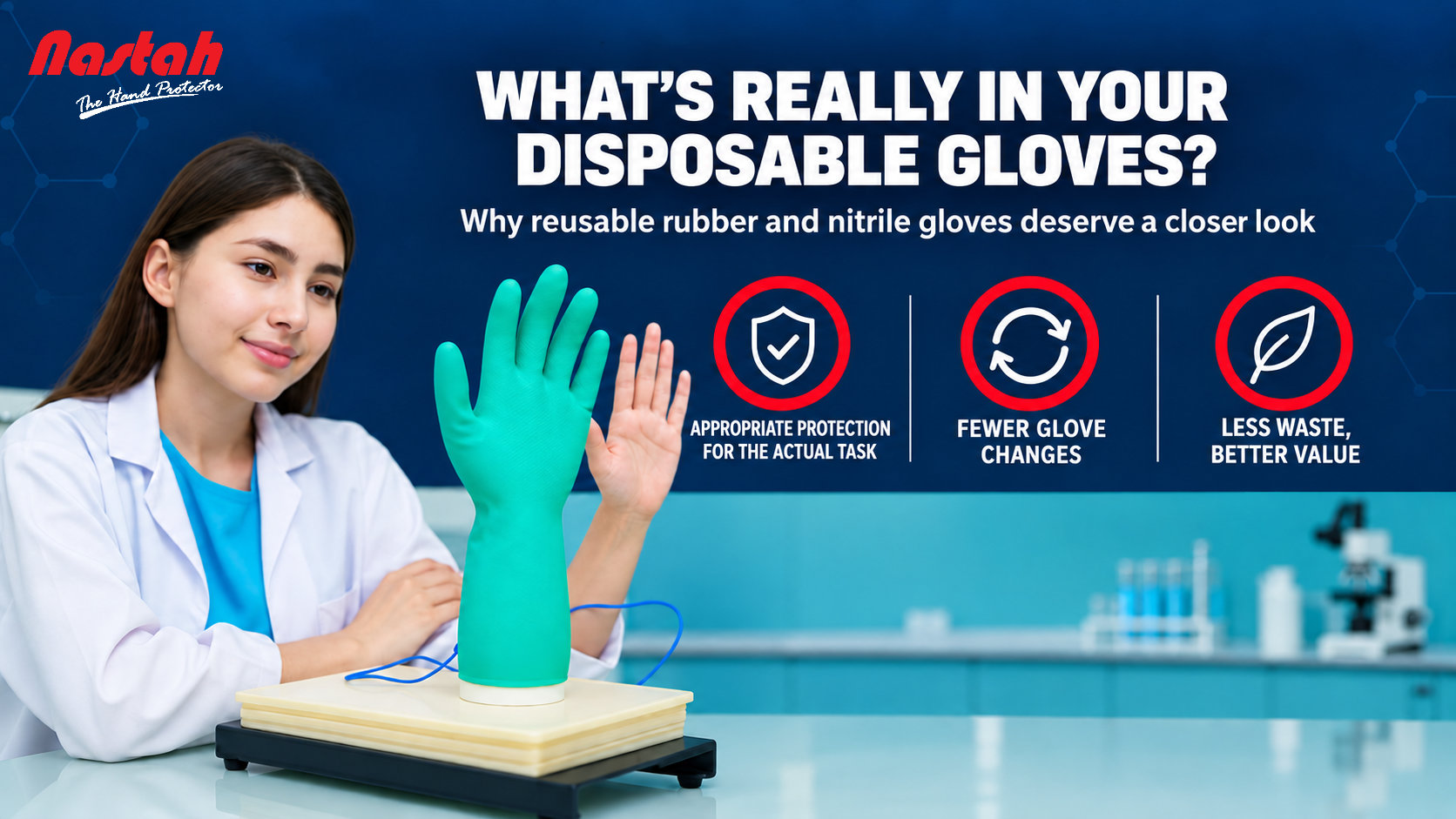
From food processing and laboratories to manufacturing, maintenance and chemical handling, millions of disposable gloves are used and discarded every day.
They are convenient, lightweight and inexpensive.
But there is a question that industrial buyers, safety managers and procurement teams may not ask often enough:
Growing research into glove formulation has drawn attention to residual processing chemicals, rubber accelerators and other substances that may be present in some disposable gloves.
For industrial applications where workers need prolonged protection rather than short-duration hygiene barriers, this raises another important question:
Is continuously replacing thin disposable gloves always the best solution—or should businesses be looking more closely at high-quality reusable rubber and nitrile gloves?
Disposable Does Not Automatically Mean Cleaner
A disposable glove may look simple, but manufacturing a nitrile or latex glove involves considerably more chemistry than most users realize.
Rubber compounds may require accelerators, curing agents, stabilizers, pigments and other processing chemicals to achieve the required elasticity, strength and physical properties.
Some of these chemicals can remain in the finished product if the formulation and manufacturing process are not carefully controlled.
A recent market study published in Contact Dermatitis analysed 48 disposable rubber gloves and found detectable rubber accelerators in 43 of them—approximately 90% of the disposable gloves tested.
Among the substances detected were zinc dibutyldithiocarbamate (ZDBC) and zinc diethyldithiocarbamate (ZDEC). Rubber accelerators are well-recognised potential causes of allergic contact dermatitis.
Perhaps even more concerning for buyers, the researchers reported that one product marketed as “accelerator free” still contained a detectable rubber accelerator.
This does not mean every disposable glove is unsafe. It does mean procurement teams should not assume that a glove is chemically clean simply because it is thin, disposable or marketed for professional use.
The Chemicals Behind Rubber Glove Manufacturing
Rubber accelerators perform an important technical function.
They help vulcanise rubber and create the elasticity, durability and strength expected from both nitrile and natural rubber gloves.
However, certain accelerators—including dithiocarbamates, thiurams, thiazoles, guanidines and thioureas—are also associated with delayed allergic contact reactions in susceptible users.
This is why the quality of the manufacturing process matters.
The U.S. FDA’s medical glove manufacturing guidance specifically recommends controlling manufacturing materials that could adversely affect finished gloves and highlights leaching and washing as methods used to remove processing chemical residues. The important takeaway for industrial glove buyers is straightforward:
The raw material printed on the box is only part of the story. How the glove is formulated, cured, washed, processed and quality-controlled can be equally important.
High-Volume Disposable Glove Use Means High-Volume Glove Contact
Consider an industrial worker changing disposable gloves repeatedly throughout an eight-hour shift.
Every replacement introduces another newly manufactured glove into direct contact with the worker’s skin.
Now multiply that across hundreds of employees, multiple shifts and an entire year.
The result can be tens or hundreds of thousands of individual glove changes.
This is one reason businesses should look beyond the simple purchase price of a disposable glove.
For operations involving chemicals, oils, cleaning agents, industrial maintenance or prolonged wet work, a properly selected reusable chemical-resistant glove can provide a fundamentally different approach.
Instead of continuously consuming thin gloves designed primarily for short-duration use, workers can use a more substantial glove engineered for repeated industrial tasks, subject to the glove manufacturer’s use, inspection and replacement recommendations.
Reusable Gloves Shift the Focus from Convenience to Protection
Reusable rubber and nitrile gloves are designed differently from typical disposable examination gloves.
They can be manufactured with greater thickness, longer cuffs, enhanced grip patterns and chemical-resistance properties intended for demanding industrial environments.
The objective is not simply to put something between the worker’s hand and the hazard.
The objective is to provide appropriate protection for the actual task. Where a thin disposable glove may need frequent replacement because of tearing, puncturing or degradation, the right reusable glove may remain functional substantially longer. That can mean fewer glove changes, less material consumption and potentially a lower total cost of ownership.
Cheap Gloves Can Carry Hidden Costs
Procurement teams understandably focus on price per pair.
But price per pair does not necessarily equal cost per use.
A disposable glove may cost only a fraction of the price of a reusable industrial glove.
But if workers must replace it repeatedly because of tearing, chemical degradation, contamination or loss of grip, the apparent saving can disappear quickly.
The true cost may include:
The better question is therefore not:
“Which glove has the lowest purchase price?”
It is: “Which glove gives our workers the appropriate protection at the most efficient cost per use?”
For many demanding industrial applications, this is where reusable gloves deserve serious consideration.
The chemical conversation becomes even more relevant when PVC or vinyl disposable gloves are included.
PVC is naturally rigid and therefore commonly requires plasticisers to make it flexible enough for use as a glove.
Certain phthalates have historically been used as plasticisers in flexible PVC products, which has led to greater scrutiny of the chemical composition and migration potential of some vinyl products.
This is an important distinction. The chemical composition of vinyl, disposable nitrile, disposable natural latex and reusable rubber gloves is not identical.
Businesses should therefore avoid treating all gloves as interchangeable commodities. Different materials bring different chemical profiles, performance characteristics and suitability for different applications.
Natural rubber remains an extremely useful glove material because of its elasticity, flexibility and mechanical properties.
However, natural rubber latex naturally contains proteins that can trigger allergic reactions in susceptible individuals.
The U.S. FDA recognizes natural rubber latex allergy and recommends synthetic alternatives such as nitrile for individuals with latex sensitivity.
Nitrile therefore offers an important alternative where natural rubber protein sensitivity is a concern.
But nitrile itself should not automatically be described as “chemical-free.” Nitrile gloves may still use rubber accelerators and other processing chemicals during production.
Once again: Manufacturing quality matters as much as material selection.
Not All Nitrile Gloves Are Created Equal
Two blue nitrile gloves can look almost identical.
Their formulation, durability and manufacturing quality may be very different.
Factors that can influence the finished glove include:
This makes supplier selection particularly important for businesses buying PPE at scale.
Rather than evaluating industrial gloves entirely on colour, thickness or price, professional buyers should consider the manufacturer behind the glove.
Ask:
How is the glove manufactured?
What standards has it been tested against?
What chemicals is it designed to resist?
How durable is it under actual working conditions?
Is it really appropriate for the substances workers handle?
Hand protection should be selected according to the hazard and application, rather than simply choosing whichever glove costs least per pair.
Disposable gloves remain appropriate for many applications.
Medical procedures, contamination-sensitive operations, food handling and short-duration tasks requiring frequent glove changes are obvious examples.
The issue is not that disposable gloves should disappear.
The problem arises when thin disposable gloves are used by default for demanding industrial tasks simply because they appear inexpensive and convenient.
Where workers are handling chemicals, oils, solvents, cleaning agents or abrasive materials for prolonged periods, the better question is:
Was the glove actually designed for this job?
Fewer Glove Changes Can Mean More Than Cost Savings
Reducing unnecessary glove changes has benefits beyond procurement cost.
High-volume disposable glove usage can also create substantial waste.
A worker who changes disposable gloves many times per shift can consume hundreds or even thousands of gloves over the course of a year.
Multiply this across an industrial facility and glove disposal can become significant.
Where workplace risk assessments permit reusable hand protection, selecting a durable reusable glove may help businesses reduce:
This makes reusable gloves worth considering not only from a protection standpoint, but also as part of a broader total cost of ownership and waste-reduction strategy.
A Better Approach to Industrial Hand Protection
Industrial hand protection should be selected around the hazard—not around habit.
For applications that require prolonged wear, chemical resistance, mechanical durability or repeated use, a properly selected reusable nitrile or natural rubber glove may provide a more suitable solution than continuously replacing thin disposable gloves.
And as awareness grows around rubber accelerators, residual processing chemicals and glove manufacturing quality, professional buyers have another reason to scrutinize exactly what they are purchasing.
A glove should protect your workers from workplace hazards—not introduce unnecessary concerns of its own.
With decades of glove manufacturing experience in Malaysia, Nastah Industries manufactures reusable nitrile, natural rubber, neoprene and specialised protective gloves for professional and industrial applications.
Whether you are an industrial end user, PPE distributor, importer, safety supplier or brand owner looking for OEM glove manufacturing, Nastah can help you identify a reusable glove solution suited to your application, protection requirements and commercial needs.
Still relying heavily on disposable gloves for demanding industrial applications?
It may be time to evaluate whether a more durable reusable glove could provide better protection, fewer glove changes and better overall value.
Contact our sales team to sales@nastah.com.my today to discuss Nastah’s glove solutions for your business.

Smart factories are getting faster, more automated and more sophisticated. But even the most advanced manufacturing...

Most PPE brands already carry an ESD glove. But look more closely at what is actually in the catalogue. In many cases,...

*Illustrative example only. Actual glove life depends on material, chemical exposure, task, mechanical stress, working...
By subscribing to our blog, you’ll be the first to know about our latest articles and insights.
Simply enter your name and email address in the form below, and select the topics that interest you.
We promise to never share your information with anyone else, and you can easily unsubscribe at any time.