The Importance of Hand Safety in the Food Industry

Industrial Hand Protection for Demanding Working Environments

Industrial operations across construction, manufacturing, surface treatment, painting and cleaning expose workers to abrasive materials, wet surfaces, oils and processing substances. These conditions require protective gloves that balance durability, flexibility, grip and comfort.

Effective hand protection goes beyond glove thickness. Material composition, grip performance and wearing comfort all contribute to safer, more efficient handling during demanding industrial tasks.

Neoprene-blended latex industrial gloves combine the protective properties of neoprene with the natural elasticity of rubber latex, offering versatile hand protection for a range of industrial applications.


Neoprene-Blended Latex Gloves in Industrial Applications

By combining neoprene with natural rubber latex, these reusable gloves provide flexibility, reliable grip and resistance to suitable industrial chemicals and oils.

Their versatility supports several industries:

  • Construction: Handling building materials, tools and wet equipment.
  • Painting and surface preparation: Working with coating materials, containers and suitable stripping substances.
  • Industrial manufacturing: Repetitive handling of components and production equipment.
  • Industrial cleaning: Handling cleaning tools, wet surfaces and compatible cleaning agents.
  • General maintenance: Equipment servicing and handling materials exposed to oils or industrial substances.


Nastah NEB2113 and NEG2812: Industrial Protection for Different Demands

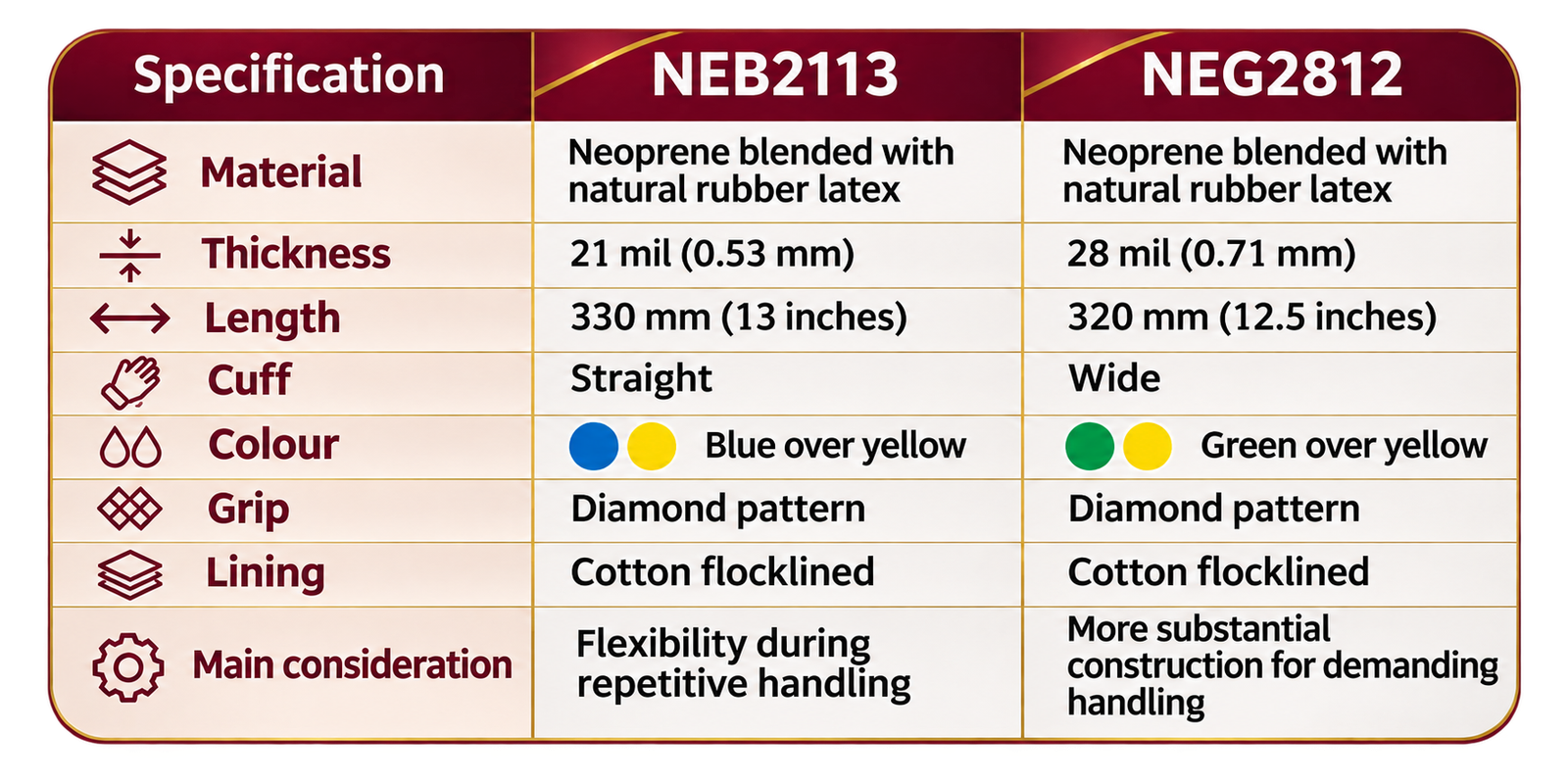
Nastah offers two neoprene-blended latex industrial gloves with different thicknesses and cuff designs to accommodate varying workplace requirements.

The Nastah NEB2113 Neoprene Blended Bi-colour Gloves feature 21 mil (0.53 mm) thickness, a 330 mm (13-inch) length and a straight cuff.

Its comparatively lighter construction prioritises flexibility and ease of movement, making it a practical choice for industrial manufacturing and painting operations that involve frequent, controlled hand movements.

From assembling production components to handling paint rollers and coating equipment, NEB2113 supports repetitive tasks requiring dexterity and consistent handling. Its diamond-pattern grip provides added control, while cotton flock lining contributes to comfortable wear throughout daily operations.


NEG2812: Heavy-Duty Protection for Industrial and Chemical Handling

The Nastah NEG2812 Neoprene Blended Bi-colour Gloves feature 28 mil (0.71 mm) thickness, a 320 mm (12.5-inch) length and a wide cuff.

With its thicker neoprene-latex construction and resistance to specified chemicals and oils, NEG2812 is a practical option for industrial work requiring a more substantial protective barrier.

It is particularly relevant to industrial maintenance, equipment cleaning and suitable chemical-handling operations, where workers encounter oils, cleaning agents and processing substances. Its heavy-duty construction also supports demanding material-handling activities in construction and manufacturing.

The wider cuff facilitates convenient donning and removal, while its PPE Category III and EN ISO 374-1 Type A classification demonstrates tested protection against specified chemicals.


Industrial Performance Beyond Basic Protection

Both NEB2113 and NEG2812 incorporate features that contribute to reliable workplace protection.


Chemical and Oil Resistance

The neoprene-latex blend provides resistance to suitable chemicals and oils, supporting industrial tasks involving exposure to compatible substances.

Secure Grip and Flexibility

Diamond-pattern grip enhances traction when handling wet or slippery materials, while natural rubber latex elasticity supports comfortable hand movement.

Comfort During Extended Wear

Cotton flock lining provides a comfortable interior, helping reduce discomfort during prolonged industrial activities.

Certified Industrial Protection

Both models are classified as PPE Category III and EN ISO 374-1 Type A, providing tested chemical resistance performance. Glove selection should follow the relevant chemical compatibility data and workplace exposure requirements.


Selecting Between NEB2113 and NEG2812

Although both gloves share a neoprene-blended latex construction, their different thicknesses and cuff designs offer distinct advantages.

There are few industries where hand safety and hygiene is as important as it is within the food industry.

Regardless of where you are in the value chain, there is a responsibility on you to maintain the highest standards of safety possible both for your customers and for your employees.

In this article, we’re going to run through some reasons why this is so important and what you can do to maintain a very high standard of hand safety.


Prevent Food Contamination.

The most obvious example is that your workers can contaminate the food you’re preparing if you’re not upholding certain standards.

We’ve seen so many examples of food-borne illness outbreaks in recent years and you don’t want to be one of those cases because it can destroy your reputation.

Ensuring that your workers are wearing the right gloves and are washing their hands regularly is a pre-requisite for this work. In most countries there will even be regulations that aim to enforce this hand hygiene – so you need to make sure that you’re doing what needs to be done here.


Avoid Accidents and Injuries.

For many food production pipelines, workers will be working with highly specialized and powerful machinery.

These machines can be dangerous if not used correctly and you want to protect your staff members wherever possible to avoid potential hand injuries.

Some things you can do here are to ensure proper training and education, provide safety gloves where necessary, encourage focus and concentration when using the machine, and invest in machines that have strong safety mechanisms.

All of these things will help avoid injuries to your workers which can hamstring your operations if you’re not careful.


Reduces Costs.

This might sound counterintuitive to some, but when you’re taking hand safety seriously, you’ll find that you can make your processes more efficient, and you’ll be dealing with a lot less waste as you move through the value chain.

This reduces costs and can improve your company’s bottom line as a result.

Safety is one of those underlying pillars that have positive knock-on effects for everything it touches so don’t underestimate how impactful it can be.


Uphold A Good Business Reputation.

There is also a social expectation on the part of your customers that you are doing everything within your power to improve hand safety within your food processing.

Customers want to know that you are prioritizing this and can often make purchasing decisions based on your reputation within the marketplace.

It’s not just the right thing to do, but it is also something that can give you a competitive edge in the market if you become known as the company that puts safety and hygiene first.


Conclusion

As you can see, hand safety and hygiene in the food industry are crucial for a number of reasons. It’s something that you cannot afford to ignore because it affects all your stakeholders including your employees and your customers.

Here at Nastah, we produce a wide range of safety gloves – some of which are perfectly suited for the food industry. If you’re looking for a reliable supplier that can help you get on top of this important need, get in touch today, and let’s see how we can help.


You May Also Like……

Be The First To Know About Our Latest Insights – Subscribe To Our Blog Today!


By subscribing to our blog, you’ll be the first to know about our latest articles and insights.

Simply enter your name and email address in the form below, and select the topics that interest you.

We promise to never share your information with anyone else, and you can easily unsubscribe at any time.